

Table of Contents
- Why Leather Gun Belts Sag: The Core Reasons
- The Science of Stiffness: Why Regular Leather Belts Fail
- Reinforced Gun Belt vs Single Layer: What Actually Prevents Sag
- Signs Your Gun Belt Is Worn Out (And What to Do)
- Gun Belt Maintenance Tips to Extend Life and Prevent Sag
- How to Choose a Heavy Duty Leather Gun Belt That Won't Sag
- Frequently Asked Questions
Last Updated: September 23, 2026
Why Leather Gun Belts Sag: The Core Reasons
A leather gun belt sags when the leather cannot carry the weight of a holstered firearm without bending. The belt curls at the holster, the gun shifts, and the whole rig starts to droop. This guide from Armour Belts breaks down why leather gun belts sag and how to fix it.

Three things cause most sag:
- Thin leather. A dress belt is built to look good, not to hold weight.
- No internal support. Single-layer leather bends under load.
- Too much weight in one spot. A full-size pistol pulls hard on a small area.
Most carry setups fail because the belt was never built for the job. A belt that folds under a holster will keep folding, no matter how tight you cinch it.
The NRA's guide to concealed carry equipment notes that a proper belt is one of the most overlooked parts of a carry system. That matches what we see: shooters spend big on holsters and skimp on the belt holding everything up.
Below, we explain the physics behind the sag, how to spot a worn-out belt, and how to pick one that holds its shape for years.
The Science of Stiffness: Why Regular Leather Belts Fail
Regular leather belts fail because they are built for fashion, not load-bearing. A dress belt is flexible on purpose. That flexibility is exactly what lets it fold under a holster.
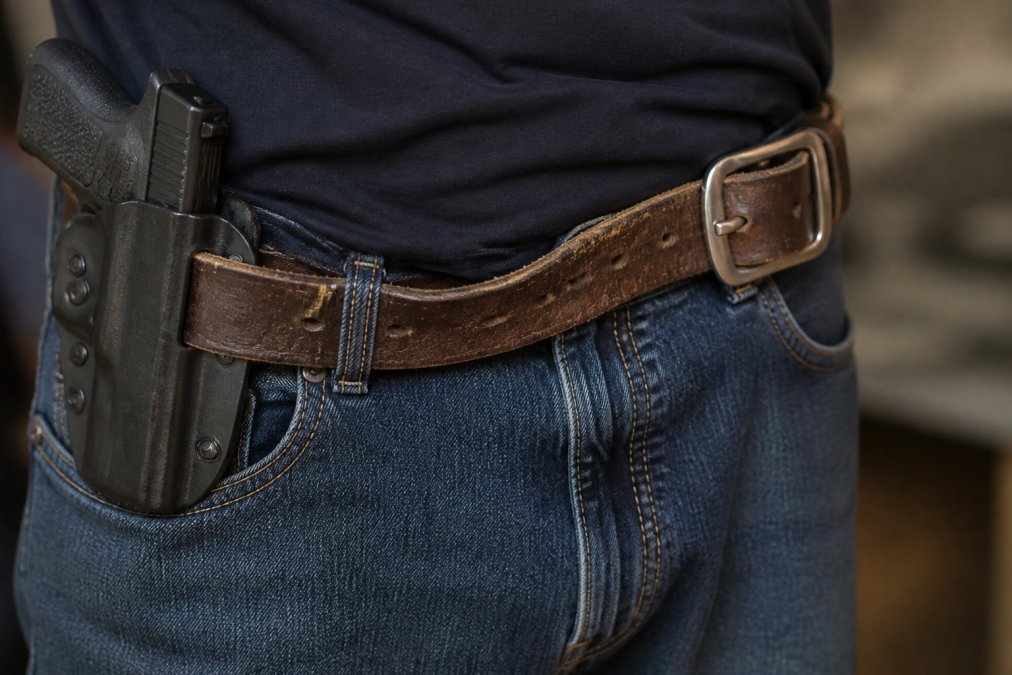
To understand why, it helps to think about the belt as a beam. When a holstered pistol hangs on one side, it applies a downward load at a single point. That load creates a bending moment, a rotational force, that tries to curl the belt around the holster. A stiff beam resists that moment; a floppy one gives in.
Three forces work against a soft belt:
- Torsion. The belt twists where the holster hangs, rotating the holster mouth away from the body.
- Compression. The leather squashes under the clip or loop, thinning at exactly the point that needs to stay thick.
- Material fatigue. Leather weakens with daily flexing, so a belt that sags a little today sags more in six months.
Here is the part most guides skip: stiffness in bending depends on two things, the material's modulus (how stiff the material itself is) and the geometry of the cross-section (how far the stiff material sits from the belt's neutral axis, the imaginary centerline that neither stretches nor compresses when the belt bends).
That second factor is why an internal stiffener works so well. Moving stiff material away from the neutral axis multiplies the belt's resistance to bending far more than simply adding thickness of the same soft leather would. A thin strip of stiff polymer or spring steel sandwiched between two leather layers can outperform a much thicker single layer of leather.
Common stiffener approaches, and what each does:
- Double-layered leather (no insert). Two layers glued and stitched back-to-back. Better than one layer, but leather still creeps and takes a set over time.
- Polymer stiffener (HDPE, Kydex, or similar). Light, will not corrode, and holds shape well. Can crack under extreme repeated flexing if it is too thin.
- Spring steel or stainless insert. Highest stiffness per unit thickness and excellent shape memory, but adds weight and can rust if moisture reaches it through a stitch line.
- Composite or layered cores. Combine materials to balance weight, stiffness, and cost. Quality varies widely, so the build matters more than the label.
Full-grain leather holds up better than bonded or split leather. The fibers are tighter and run the full length of the hide, so it resists tearing at the bend points. But even good leather needs help. That is where the internal stiffener comes in, and where the difference between a belt that lasts a year and one that lasts a decade is decided.
Reinforced Gun Belt vs Single Layer: What Actually Prevents Sag
A reinforced gun belt beats a single-layer belt every time for carry. The difference comes down to one thing: an internal stiffener.
A single-layer belt is just leather. It bends wherever you pull it. Add a full-size pistol and a spare mag, and the belt loses its shape fast.
A reinforced belt adds a stiff core between layers of leather. That core spreads the load across the whole belt instead of one small spot. The result is a belt that stays flat and keeps the holster locked in place.
| Feature | Single-Layer Belt | Reinforced Gun Belt |
|---|---|---|
| Internal stiffener | No | Yes |
| Holds holster upright | Poorly | Consistently |
| Handles full-size pistol | No | Yes |
| Resists torsion | Weak | Strong |
| Lifespan under daily carry | Short | Years |
Weight distribution matters as much as stiffness. A reinforced belt spreads carry weight around your waist. That means less pressure on one hip and less sag over a long day.
The Armour Belts Gun Belt is built this way. It uses full-grain leather at about 5/16" thick, cut to your measurement and stitched with military-grade nylon thread. That build is what keeps an IWB or appendix holster from rolling.
Signs Your Gun Belt Is Worn Out (And What to Do)
A worn gun belt shows clear warning signs before it fails completely. Catch them early and you avoid a holster that shifts when you need it most.

Watch for these:
- A permanent curve where the holster sits
- Stretched holes that no longer hold tight
- Cracked or flaking finish along the bend points
- A soft, floppy feel when you hold it by one end
- Stitching that has pulled loose near the buckle
The curve is the big one. Once leather takes a set, it rarely comes back. That bend is where the belt will keep folding.
Run a Sag Test at Home
You do not have to guess whether your belt is done. You can measure it. This simple protocol gives you a repeatable number instead of a vague feeling.
The test:
- Hang the belt over the rod at the point where your holster normally sits, so the belt drapes down on both sides.
- Attach the weight to the belt at the holster position, centered on the rod.
- Measure how far the belt's bottom edge drops below the rod after 60 seconds.
- Repeat on the opposite side (the support side, where a spare mag or nothing rides) and compare.
How to read the result:
- Under about 1 inch of drop. The belt is still carrying its share of the load. Keep using it.
- Roughly 1 to 2 inches. The belt is softening. It may still work for a compact pistol but will likely fail with a full-size gun.
- More than about 2 inches, or a visible kink at the load point. The belt has taken a set. Replace it.
Gun Belt Maintenance Tips to Extend Life and Prevent Sag
Gun belt maintenance comes down to three habits: keep it dry, condition it lightly, and store it flat. Do these and a good belt lasts for years.

How to Choose a Heavy Duty Leather Gun Belt That Won't Sag
A heavy duty leather gun belt should be thick, stiff, and cut to your exact size. Those three traits separate a belt that lasts from one that droops in a month.
Here is what to look for:
- Full-grain leather. Skip anything labeled "genuine" or "bonded."
- Around 5/16" thick. Thin belts cannot carry a full-size pistol.
- An internal stiffener. This is what stops the roll.
- Military-grade stitching. Weak thread fails at the buckle.
- A cut-to-measure fit. Pant size is not belt size.
- A real warranty. It signals the maker stands behind the build.
Frequently Asked Questions
How to fix belt sag?
Fixing belt sag starts with identifying the cause. If your belt is made of soft leather, it lacks the stiffness to support a holster. A quick fix is to tighten the belt, but that only masks the problem. For a long-term solution, switch to a heavy duty leather gun belt with an internal stiffener. Armour Belts offers handcrafted full-grain leather belts about 5/16 inch thick, designed to stay flat under a holster. Proper measurement, including carrying your holster when sizing, also prevents sag.
What is the best material for a gun belt?
Full-grain leather is the best material for a gun belt because it is dense, durable, and resists stretching. Unlike split leather or bonded leather, full-grain leather maintains its shape under load. For added rigidity, some belts include an internal stiffener like Kydex. Armour Belts uses full-grain leather and offers an optional Kydex stiffener insert. This combination provides the structural integrity needed to prevent sagging, even with heavy holsters.
Does a reinforced core prevent leather belt sagging?
Yes, a reinforced core significantly reduces sagging. A reinforced gun belt vs single layer: the core, often made of Kydex or nylon, adds rigidity that distributes weight evenly. Single-layer leather belts, even thick ones, can stretch and fold over time. A reinforced belt maintains its shape, keeping your holster secure. Armour Belts offers belts with an optional Kydex stiffener insert, which makes the belt exceptionally sturdy and prevents the holster from rolling.
How long should a leather belt last?
A high-quality full-grain leather gun belt can last a decade or more with proper care. Armour Belts customer reviews mention belts worn daily for years that remain rigid and high quality. Factors like leather thickness, stitching, and maintenance affect longevity. Belts made from full-grain leather, like Armour Belts, are stitched with military-grade nylon thread and come with a lifetime warranty on materials and workmanship. Regular conditioning and avoiding over-tightening can extend life further.
Share:
How to Measure Waist for a Gun Belt: 2026 Guide
Benefits of Thick Leather Gun Belts for Carry