
Table of Contents
- Why a Dedicated Gun Belt Beats a Standard Leather Belt
- The Core of a Good Carry Setup: Rigidity and Stiffness
- Leather vs Nylon Gun Belts: Which Material Is Right for You?
- How to Measure Belt Size Accurately for Your Holster
- Belt Width, Buckles, and Holster Compatibility
- Weight Distribution, Sag Prevention, and All-Day Comfort
- Conclusion
- Frequently Asked Questions
Last Updated: September 28, 2026
Why a Dedicated Gun Belt Beats a Standard Leather Belt
A dedicated gun belt holds a holster in place; a standard leather belt holds up pants. That difference matters the moment you add a loaded pistol.

Most people start carrying with the belt already in their closet. It works for a week, then the leather folds, the holster rolls outward, and you spend the day hitching your waistband up. At Armour Belts, we hear that story constantly.
The core difference is construction. A dress belt is thin, flexible, and designed to bend. A gun belt is thicker, stiffer, and designed to resist bending under load. According to federal firearms statistics from the Bureau of Alcohol, Tobacco, Firearms and Explosives, millions of Americans hold concealed carry permits, and most will replace their first carry belt within a year. That replacement is avoidable.
A belt that folds under weight sags, prints, and makes all-day carry uncomfortable.
The Core of a Good Carry Setup: Rigidity and Stiffness
Rigidity is the single most important property of a concealed carry belt. A rigid belt distributes the firearm's weight across your waist instead of letting it hang from one point.
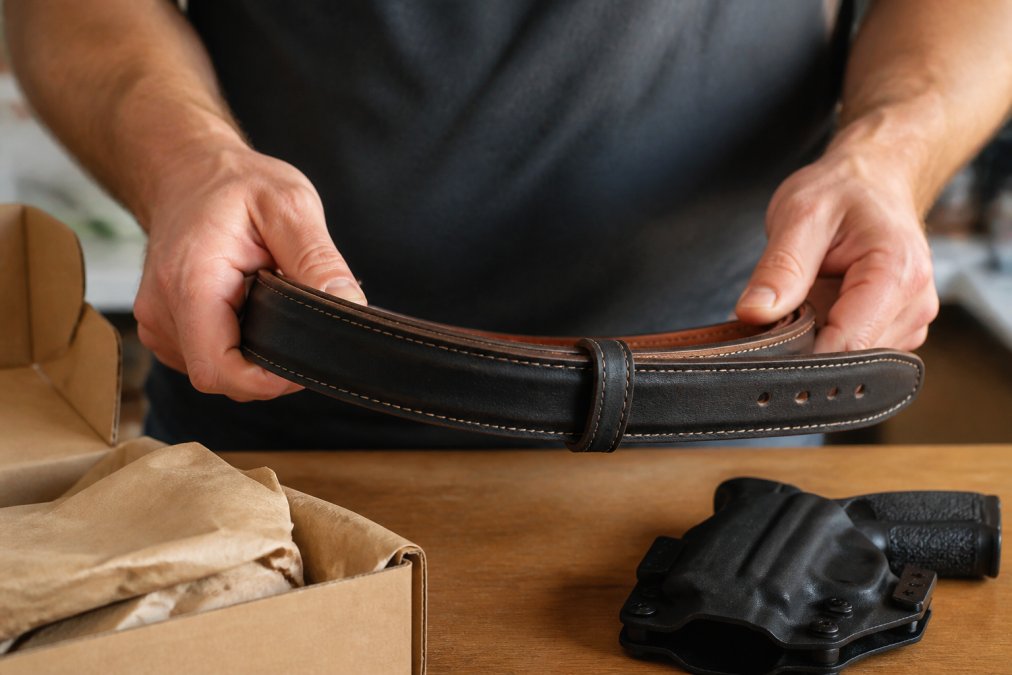
The Concealed Carry Belt Stiffness Test
The fastest stiffness test: hold the belt by both ends and try to fold it in half. A proper gun belt resists and springs back toward flat rather than staying creased.
Here is what to look for:
- Roll test: Wrap the belt around your hand. If it collapses into a tight circle with no resistance, it will sag under a holster.
- Edge test: Pinch the edge between your thumb and finger. Full-grain leather feels dense and solid; bonded leather feels spongy.
- Recovery test: Fold the belt and let go. A belt that holds the crease has already lost its structure.
Leather vs Nylon Gun Belts: Which Material Is Right for You?
Leather and nylon gun belts serve different purposes. Leather suits everyday concealed carry and dressier clothing; nylon suits range use, competition, and open carry.
Polymer Core and Reinforced Webbing Options
Some nylon belts use a polymer core or reinforced webbing to add stiffness without much weight, and these designs can be genuinely rigid under heavy loads.
How to Measure Belt Size Accurately for Your Holster
Measuring for a gun belt differs from measuring for a dress belt, and getting it wrong is the most common mistake we see. Do not send your pant or waist size. Measure the belt itself.
Measuring With Your Holster In Place
If you carry inside the waistband, measure with the holster on your body. The holster adds thickness between you and the belt, changing the effective circumference.
Here is the process:
- Put on your pants and holster exactly as you carry.
- Run a soft tape measure through your belt loops, over the holster.
- Note the measurement where the tape meets comfortably, not tightly.
- Order that measurement, not your pants size.
Belt Width, Buckles, and Holster Compatibility
Belt width determines which holsters and clips fit, so match it to your holster first. Most inside-the-waistband holsters and clips are built for 1.5" belts. Buy a 1.75" belt for a holster with a molded plastic clip sized for 1.5", and the clip will not seat fully, so the holster shifts no matter how tight you cinch.

| Width | Best For | Stitching | Notes |
|---|---|---|---|
| 1.25" | Tight belt loops, low-profile carry | Single row | Slimmer look, same thickness |
| 1.5" | Most compact and full-size pistols | Two rows | The workhorse width |
| 1.75" | Heavy loads, open carry, competition | Two rows | Maximum stability |
1.25-Inch vs 1.5-Inch vs 1.75-Inch Widths
For most carriers, 1.5" is the correct answer: it fits the widest range of holsters, clips, and belt loops and offers plenty of surface area to distribute weight.
How Belt Width Interacts With Holster Clips and Loops
The belt-holster interface is where most carry problems start. A clip or loop grips the belt by clamping it against the waistband, and that grip depends on the belt's thickness and its width matching the hardware's designed opening.
- Plastic clips (common on many IWB holsters) are molded to a specific belt width. A 1.5" clip on a 1.75" belt will ride up on the belt's edge and tilt the holster outward, which prints.
- Metal clips often have a slightly wider tolerance but still rely on belt thickness for grip. A belt that is too thin lets the clip slide along the belt during the day.
- Leather or nylon loops (snap or pull-the-dot) wrap fully around the belt, so they are more forgiving of width but demand consistent thickness. A belt that tapers or varies in thickness will let the holster rotate.
Buckle Types and Adjustment Mechanisms
Buckles matter less than people think, but they should be secure and swappable. A buckle held on with Chicago screws lets you change hardware later without buying a new belt.
Weight Distribution, Sag Prevention, and All-Day Comfort
Sag prevention is a function of weight distribution, which depends on belt stiffness, fit, and body type. Get those right and most comfort problems disappear; get them wrong and no amount of tightening will fix it.
The Physics of Belt Tension and Holster Grip
Most guides stop at "get a stiff belt." The mechanism that keeps a holster from shifting is friction plus normal force at the belt-holster interface.
How Body Type Changes the Load Path
Waist-to-hip ratio and body composition change where a belt carries load and how it feels.
- Straighter waist-to-hip ratio: The belt has less natural shelf to sit on, so it relies more on tension to stay up. These carriers benefit most from a wider, stiffer belt that spreads load and resists sliding down.
- More pronounced hip flare: The belt naturally rests on the hips, which reduces the need for high tension but can create pressure points at the hip bones if the belt is too wide or too stiff at the edges.
- Higher body fat percentage around the midsection: Soft tissue compresses under belt tension, so the belt can feel tight when standing and loose when sitting. A belt with closely spaced adjustment holes or a ratchet mechanism handles this shift better than a fixed-hole belt.
- Lower body fat percentage: Less padding means the belt's edges press directly against bone and muscle. A belt with finished, rounded edges and a slightly narrower width is often more comfortable.
Carry Position and Comfort
- Appendix carry (front of hip): The holster sits forward, so the belt wraps around it and the load pulls forward and down. A belt that is stiff front-to-back matters more than raw width here.
- Strong-side hip carry: The load sits on one hip, so the belt must resist twisting. A wider belt with two rows of stitching resists that twist better than a narrow single-row belt.
- Behind-the-hip carry: The holster sits over the glute, where the body curves. A belt that holds its shape around a curve prevents the holster from tipping outward and printing.
All-day comfort also depends on the belt-holster interface. Clips and loops need consistent thickness to grip; a belt that varies in thickness lets the holster shift, and shifting means readjusting, which means printing.
Long-Term Care and Stretch Resistance
A belt that sags after six months usually stretched, not wore out. Leather stretches when it absorbs moisture and dries under load, so rotate two belts, let each dry fully between wears, and condition leather sparingly rather than soaking it. Nylon and polymer-core belts resist stretching better but can fray where clips rub, so inspect the clip contact points periodically.
Conclusion
Choosing the right carry belt comes down to three measurements and one material decision: your actual belt size, your holster's required width, and how much weight you carry, matched to a leather or nylon build that can hold it. Get those right and the belt disappears into the background.
Frequently Asked Questions
What type of belt is best for concealed carry?
A dedicated concealed carry belt made from full-grain leather or reinforced nylon is best. Look for a belt that is at least 1.5 inches wide and around 5/16 inch thick. The belt must be stiff enough to prevent your holster from sagging or shifting. Avoid standard dress belts, which fold under weight and cause printing. A purpose-built gun belt distributes the weight of your firearm evenly across your waistline, keeping your carry setup stable and concealed all day.
How do I measure my waist for a gun belt?
Do not use your pant size. Measure a belt you already own that fits well, from the buckle fold to the hole you use most. If you carry inside the waistband, measure around your waist with your holster in place. A gun belt that is even 1 inch off will not fit correctly. Armour Belts provides measuring instructions on their site, and each belt is cut to your exact measurement rather than a generic size.
How thick should a concealed carry belt be?
Most concealed carry belts range from about 1/4 inch to 5/16 inch thick. Thicker belts provide more stiffness, which prevents your holster from rolling outward and causing printing. However, a belt that is too thick may not fit through all belt loops or holster clips. Armour Belts offers options like the Casual Gun Belt at just under 1/4 inch and the Gun Belt at about 5/16 inch, so you can match thickness to your carry style and clothing.
What is the difference between a reinforced and non-reinforced gun belt?
A reinforced gun belt has a stiffener, often a polymer core or Kydex insert, sandwiched between layers of leather or nylon. This core adds rigidity and prevents the belt from stretching or sagging over time. Non-reinforced belts rely on thick leather or webbing alone for stiffness. Reinforced belts generally hold up better under the weight of a full-size pistol and extra magazines. Armour Belts offers an optional Kydex stiffener insert on their Casual Gun Belt for added support.
Share:
Hanks Belts vs Daltech Force: Which Gun Belt Wins?
How to Stop Holster Shifting: A Complete 2026 Guide