
Table of Contents
- Hanks Belts vs Daltech Force: A Head-to-Head Comparison
- Material Durability and Long-Term Wear Analysis
- Synthetic vs Leather Gun Belts: Which Is Right for You?
- How to Choose a Gun Belt Thickness for Your Carry Setup
- Gun Belt Sizing Guide: Getting the Right Fit
- Hardware, Stitching, and Buckle Quality Compared
- Holster Compatibility and Concealment Profile
- Price-to-Value: What You Get for Your Money
- Frequently Asked Questions
Last Updated: September 27, 2026
Hanks Belts vs Daltech Force: A Head-to-Head Comparison
Choosing between Hanks Belts vs Daltech Force comes down to one question: do you want the stiffness and long-term character of full-grain leather, or the lighter, lower-maintenance profile of reinforced nylon? This comparison from Armour Belts breaks down materials, hardware, sizing, and concealment so you can pick the right gun belt for daily carry.

Leather vs. Nylon: What Each Brand Does Best
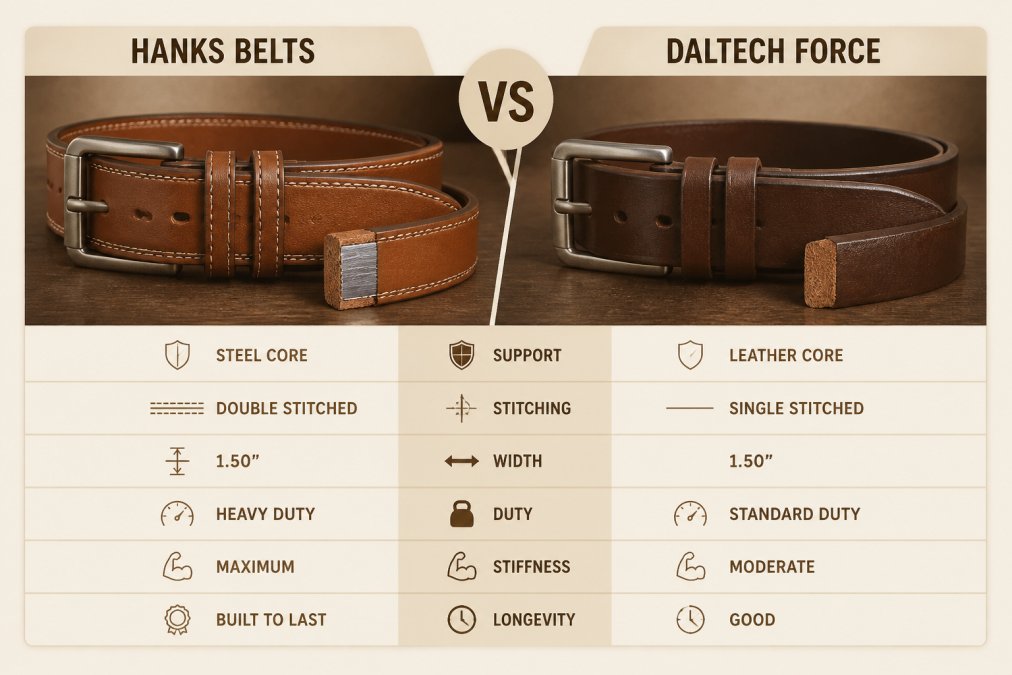
Hanks Belts does leather. Daltech Force does synthetic. That split explains most of the differences you'll feel on day one.
NIJ body armor and equipment standards overview
Material Durability and Long-Term Wear Analysis
Durability is where the two brands diverge most. Full-grain leather is the top layer of the hide, so it keeps the tight fiber structure that gives a belt its tensile strength. Reinforced leather and nylon rely on an internal core instead. The difference shows up at month twelve, not day one.
A 12-Month Wear-Point Breakdown
Most reviews judge a belt in the first week, when everything looks new. A more useful frame is the four points that actually degrade, in order:
- The hole you use most (months 1-3). On leather, the hole compresses and burnishes but keeps its shape because the fibers rebound. On nylon, the weave loosens first; under a holster's constant load the hole can elongate into an oval, letting the belt shift and the holster ride lower.
- The buckle attachment (months 3-6). Chicago screws can back out if they aren't thread-locked; fixed rivets don't loosen but can't be serviced. This is the first place a cheap belt announces itself.
- Stitching near the holster clip (months 6-12). This is the highest-stress zone on any carry belt. A holster clip presses and releases against the same few inches of belt dozens of times a day. Single-row stitching on thin leather frays first; double-row stitching on a full-grain strap lasts longest.
- The strap body (months 12+). Full-grain leather softens and molds to your waist but keeps its rigidity across the width, so it resists sag. Nylon holds its shape until the internal stiffener fatigues, then sags suddenly rather than gradually, hard to predict and impossible to repair.
- Leather: ages gracefully, resists sag, repairable
- Nylon: resists moisture, lighter, but harder to repair
- Steel core: adds rigidity, but adds weight
- Stitching: double rows outlast single rows under load
Why the Failure Point Matters More Than the Material
Two belts made from the same full-grain hide can last very different lengths of time depending on how the maker finishes the stress points. Burnished, sealed edges resist moisture wicking into the grain; raw cut edges invite it. A buckle attachment reinforced with a second layer of leather outlasts one on a single thickness.
Full-Grain Leather vs. Reinforced Leather
Full-grain leather keeps the entire grain layer intact, which is why it holds up for years with basic care. Reinforced leather bonds a stiffener to a thinner leather shell: stiffer out of the box, but it can delaminate over time, and once the layers separate, the belt is done.
Synthetic vs Leather Gun Belts: Which Is Right for You?
Synthetic gun belts win for hot, humid climates and quick on-off use. Leather gun belts win for daily carry, dressier settings, and long-term value.
| Factor | Leather | Synthetic (Nylon/Steel Core) |
|---|---|---|
| Break-in | Short, expected | None |
| Moisture resistance | Moderate | High |
| Weight | Heavier | Lighter |
| Longevity | Years with care | Varies by core quality |
| Dress compatibility | High | Low |
| Sag resistance | High (material) | High (core) |
How to Choose a Gun Belt Thickness for Your Carry Setup
Thickness drives stiffness, and stiffness drives sag resistance. For most IWB and appendix setups, a belt around 5/16" thick gives the rigidity you need without feeling like a plank. Thinner belts, closer to 1/4", suit lighter pistols and tighter loops.
Here's how to match thickness to your setup:
- Full-size pistol with light: 5/16" or thicker
- Compact pistol, IWB: 5/16" is the sweet spot
- Subcompact, appendix: 1/4" to 5/16"
- Heavy mag pouch or gear: go thicker, never thinner
Gun Belt Sizing Guide: Getting the Right Fit
Measure a belt that already fits, not your waist or pant size. That rule prevents almost every sizing return, waist size and belt size are different numbers, and a gun belt an inch off is a bad belt.

- Measure an existing belt from buckle fold to the hole you use
- Add length for IWB holster bulk
- Never send pant size as belt size
- Check the maker's measuring instructions before ordering
Hardware, Stitching, and Buckle Quality Compared
Hardware is where cheap belts quietly fail. Buckle attachment, stitching density, and fastener durability decide whether a belt lasts five years or five months.
- Chicago screws: swappable, serviceable
- Fixed rivets: strong, but permanent
- Double stitching: better for heavy loads
- Nylon thread: resists moisture and rot
Holster Compatibility and Concealment Profile
Holster compatibility comes down to three numbers, not one: belt width, belt thickness, and stiffness. Most reviews only cover width, which is why so many carriers end up with a belt that fits the holster but won't thread the clip.
The Thickness-to-Clip Compatibility Matrix
Belt thickness is measured in fractions of an inch, and holster clips are built with a fixed gap. Too thick and the belt won't seat fully, so the holster rides high and shifts; too thin and the holster rocks. Here's how common thicknesses interact with the main clip types:
| Belt Thickness | IWB Clip (plastic/Kydex) | IWB Metal Clip | OWB Paddle/Loop | Pants Belt Loops |
|---|---|---|---|---|
| 1/4" | Seats fully, slight rock | Seats fully | Seats fully | Threads easily |
| 9/32" | Seats fully, minimal rock | Seats fully | Seats fully | Threads easily |
| 5/16" | Snug; some plastic clips won't close | Seats fully | Seats fully | Threads with effort |
| 11/32" | Often won't seat in plastic clips | Snug; may need adjustment | Seats fully | Tight; some loops won't pass |
| 3/8" | Won't seat in most plastic clips | Snug to tight | Seats fully | Won't thread most dress loops |
A few practical takeaways from that table:
- Plastic and Kydex IWB clips are the least tolerant of thickness. Stay at or below 5/16" or verify the clip's stated gap before ordering.
- Metal clips and OWB loops are the most tolerant. They flex or open, so they handle thicker belts that plastic clips reject.
- Pants belt loops are the hidden constraint. A 3/8" belt that fits your holster perfectly may not thread through dress pants or chinos. Measure a loop before committing.
- Thickness and stiffness aren't the same thing. A 5/16" full-grain leather belt and a 5/16" steel-core nylon belt can have very different stiffness, changing how the holster sits even when the clip fits identically.
Concealment Profile: Why Flat Beats Thick
Concealment profile depends on how flat the belt sits, not how thick it is. A stiff belt that stays flat keeps the holster tight to the body, which reduces printing. A belt that rolls or sags pushes the grip outward and gives you away.
- 1.5" width: best for most full-size and compact pistols
- 1.25" width: best for tight loops and low-profile carry
- Stiffness: keeps the holster from rolling
- Flat profile: reduces printing under a shirt
- Full-width stiffener: resists twisting better than a center-only core
Price-to-Value: What You Get for Your Money
Price-to-value here isn't about the lowest sticker. It's about cost per year of use. A belt that lasts a decade costs less per year than a cheap belt replaced every season.
| Belt | Price | Best For |
|---|---|---|
| Casual Gun Belt | $119 | Everyday carry, thinner profile |
| Gun Belt | $125 | IWB and appendix carry |
| Gun Belt Max | $130 | Heavy setups, full-size pistols |
| Armour Ozarks Tactical Nylon Belt | $120 | Competition, quick on-off |
| Sharkskin Inlay Gun Belt | $150 | Dress carry, refined look |
Frequently Asked Questions
Are Hanks Belts really worth the investment for daily concealed carry?
Hanks Belts are known for full-grain leather construction and a lifetime warranty, which appeals to daily carriers. The real question is whether the specific thickness and stiffness match your holster and carry position. A gun belt that is too stiff can be uncomfortable for appendix carry, while one that is too flexible will sag under a full-size pistol. Focus on measured thickness, width, and how the belt distributes weight rather than brand reputation alone.
What are the primary differences between Hanks Belts and Daltech Force construction?
Hanks Belts typically uses full-grain leather with steel or polymer cores in some models, while Daltech Force offers both reinforced leather and synthetic options. The key differences come down to core material, stitching pattern, and buckle attachment method. Leather belts with a steel core resist sagging better under heavy loads, but they take longer to break in. Synthetic belts are lighter and dry faster, though they may not hold their shape as long under constant holster pressure.
How do synthetic gun belts from Daltech Force compare to traditional leather?
Synthetic gun belts are lighter, resistant to moisture, and often require no break-in period. They work well for competition or hot-weather carry. Traditional leather, especially full-grain with a stiffener, molds to your body over time and provides consistent rigidity for holster retention. The trade-off is weight and maintenance. If you carry a heavy pistol daily, leather usually holds up better long-term; if you want something low-maintenance for range days, synthetic is a solid choice.
What should I look for in a leather gun belt for concealed carry?
Look for full-grain leather, not bonded or split leather, which delaminates over time. Check the thickness: 5/16 inch or about 8-9 mm is common for stiff carry belts. Stitching should be military-grade nylon or heavy polyester, not cotton. The buckle should attach with Chicago screws so you can replace it. Finally, measure with your holster in place if you carry inside the waistband. A gun belt that is 1 inch off will not support your setup properly.
Which gun belt offers better support for heavy full-size handguns?
Belts with a steel core or reinforced leather core generally support full-size handguns better than synthetic belts because they resist rolling and sagging. Thickness matters too: a 5/16-inch belt with two rows of stitching distributes weight more evenly than a thinner belt. For a full-size pistol with a light and spare magazine, a 1.5-inch wide belt with a stiff core is the common recommendation. Always match belt stiffness to your carry position and holster type.
The real challenge isn't picking a belt that works today. It's picking one that still holds your holster tight after years of daily carry. Armour Belts handcrafts full-grain leather gun belts in Michigan, cut to your exact measurement, with military-grade stitching and a lifetime warranty on materials and workmanship. Get started with Armour Belts and carry with a belt built to perform every day.
Share:
Benefits of Thick Leather Gun Belts for Carry
How to Choose a Concealed Carry Belt: The 2026 Guide