
Table of Contents
- Full Grain vs Bonded Leather Belts: The Short Answer
- What Full-Grain Leather Actually Is
- What Bonded Leather Actually Is
- Side-by-Side Comparison: Full Grain vs Bonded Leather Belts
- How to Identify Full-Grain Leather Before You Buy
- Full-Grain Leather Belt Durability: What Years of Daily Wear Looks Like
- Bonded Leather Belt Cracking and Peeling: Why It Happens
- Full-Grain vs. Top-Grain Leather Belts: Where Top Grain Fits In
- Which Leather Belt Fits Your Carry Setup?
- Frequently Asked Questions
Last Updated: October 9, 2026
Full Grain vs Bonded Leather Belts: The Short Answer
The difference between full grain vs bonded leather belts comes down to what the leather actually is. Full-grain leather is the whole top layer of the hide, fibers intact, and it holds up for years. Bonded leather is leather scraps and dust glued together with binder, and it tends to crack and peel within months of daily wear.
At Armour Belts, we handcraft every belt in Michigan from full-grain leather, so we have a strong view on this. A belt is not a place to save money. It sits under load every day, and the material either holds that load or it does not.
Below, we break down what each material is, how to spot the difference in a store, and which belt fits the way you actually carry.
What Full-Grain Leather Actually Is
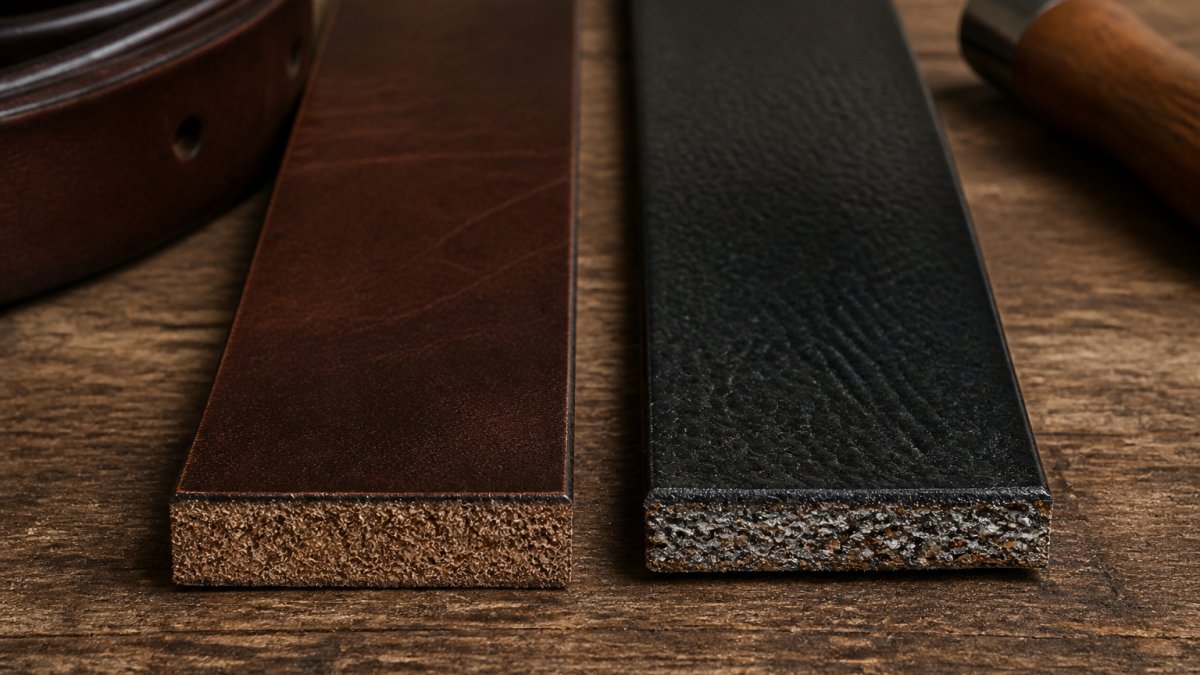
Full-grain leather is the outermost layer of the hide with the hair removed and the surface left intact. Nothing is sanded off, buffed down, or glued on. The tight fiber structure stays whole, which is why it resists stretching and takes years of flexing without splitting.
That intact grain is also why full-grain leather develops a patina instead of wearing out. Scratches burnish. Color deepens. The belt looks better at year five than it did at year one.
The trade-off is honesty. Full-grain shows every natural mark, brand, and grain variation. If you want a flawless plastic-smooth surface, this is not the material for you. leather terminology guide from the Leather Research Laboratory
What Bonded Leather Actually Is
Bonded leather is a manufactured sheet made from leather fibers, shavings, and dust left over from other production, bonded together with a latex or polyurethane binder and pressed onto a fabric or paper backing. The leather content varies widely, and some products sold as bonded leather contain very little actual leather fiber.
Think of it as particle board for belts. The surface is a thin finish coat, not the hide itself. That finish is what fails first. Flex it repeatedly at the buckle and the coating separates from the backing.
The material is cheaper, lighter, and easier to finish to a uniform look. Those are real advantages for a fashion belt that gets worn a few times a year. They are not advantages for a belt that carries a holster.
Side-by-Side Comparison: Full Grain vs Bonded Leather Belts
Here is how the two materials stack up on the things that matter for daily wear.
| Factor | Full Grain | Bonded |
|---|---|---|
| Material | Whole top layer of hide | Leather fibers bonded with adhesive |
| Thickness | Substantial, holds shape | Thin, flexible, flattens |
| Lifespan | Years of daily wear | Months before surface failure |
| Failure mode | Surface marks, patina | Cracks, peels, splits at buckle |
| Support under weight | Stays flat, resists roll | Sags and folds |
| Repairable | Yes, edges and holes can be redone | No |
| Cost | Higher upfront | Lower upfront, replaced often |
The cost column is where bonded leather loses the argument over time. Federal Trade Commission guidance on leather labeling requires accurate disclosure of what a product is made of, so the label is a starting point, not a marketing claim.
How to Identify Full-Grain Leather Before You Buy
You can identify full-grain leather in a store in under a minute without any tools. Look at the cut edge, look at the surface under raking light, and bend the belt. The three checks below catch most mislabeled belts.
Edge, Grain, and Smell Tests You Can Do in the Store
- Edge test: Look at the cut end. Full grain shows a solid, dense cross-section. Bonded leather shows a sandwich: a thin top coat, a fibrous middle, and a fabric backing.
- Grain test: Full grain has visible pores and irregular natural markings. Bonded leather has a uniform, printed pattern that repeats.
- Bend test: Fold the belt firmly at the buckle end. Full grain creases and springs back. Bonded leather shows a sharp white line where the finish is about to crack.
- Smell test: Real leather smells like leather. Bonded leather smells like glue or plastic.
- Weight test: Full grain has heft. Bonded leather is noticeably light for its size.
Full-Grain Leather Belt Durability: What Years of Daily Wear Looks Like
Full-grain leather belt durability shows up in the details after years of use. The edges stay sealed. The holes keep their shape instead of stretching oval. The belt still stands up on its own when you hold it by the buckle.
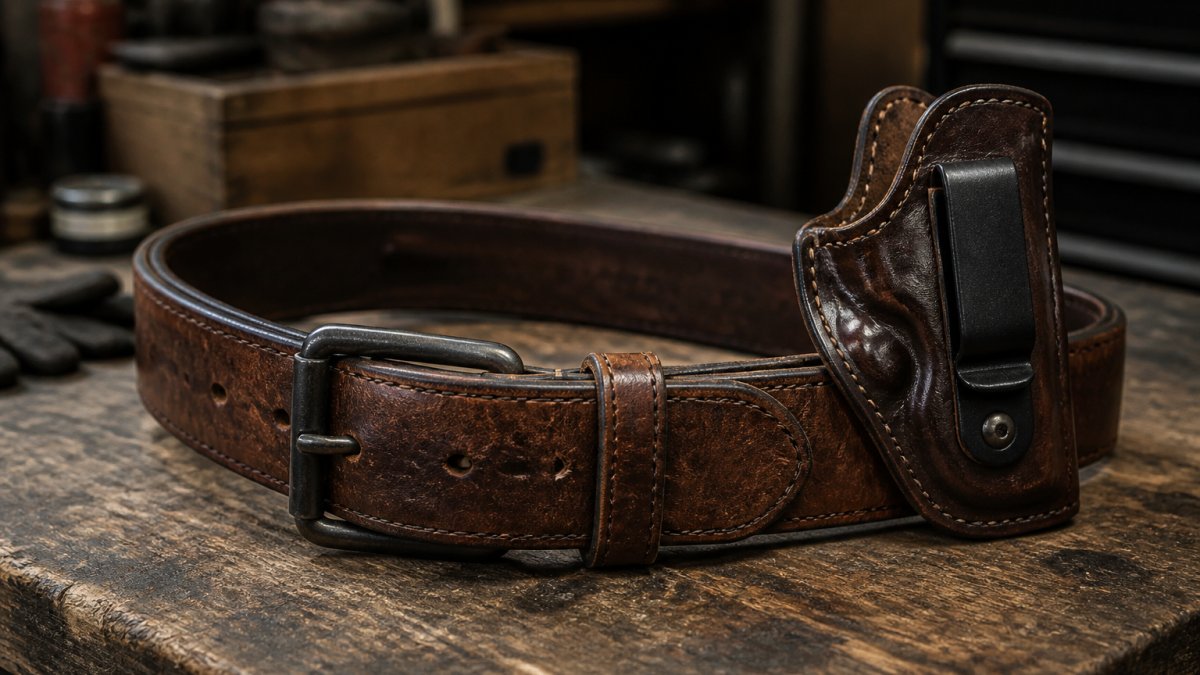
What most guides miss is that stiffness is the point. A gun belt has to resist rolling under the weight of a holster, and that resistance comes from thickness and fiber integrity. Our Gun Belt runs about 5/16" thick and is built to stay flat under an IWB or appendix holster. It starts stiff on purpose, and that stiffness is what keeps the holster from sagging.
A common mistake is judging a new gun belt by how it feels on day one. It should feel like a piece of equipment, not a fashion accessory. The break-in is short, and what you get on the other side is a belt that carries the same way in year three as it did in week one.
Bonded Leather Belt Cracking and Peeling: Why It Happens
Bonded leather belt cracking and peeling starts at the buckle. Every time you fasten and unfasten the belt, the material flexes at the same point. The finish coat is bonded to a backing that flexes differently, so the two layers separate. Once a crack opens, moisture gets in and the split runs along the belt.
The failure is mechanical, not a matter of care. You cannot condition a bonded belt back to health because there is no fiber structure underneath the surface to restore. This is why bonded belts tend to fail on a schedule rather than a lifespan.
The same pattern shows up at the holes and the tip. Stretching at the holes turns them oval, and the tip frays where the finish has worn through.
Full-Grain vs. Top-Grain Leather Belts: Where Top Grain Fits In
Top-grain leather is the layer just below the full-grain surface, and it is sanded and refinished to remove imperfections. It is real leather, and it is a step above bonded. It is also thinner and less abrasion-resistant than full grain because the strongest part of the hide has been removed.
For a dress belt that sees light use, top grain is a reasonable choice. For a belt that carries weight every day, the removed surface is exactly the part you wanted.
This is the distinction most belt shoppers never hear: full grain and top grain are both real leather, but only one of them keeps the layer that resists stretch and roll. When you are comparing full grain vs. top grain leather belts for carry use, the answer is full grain.
Which Leather Belt Fits Your Carry Setup?
Match the belt to what you carry and how you carry it. A full-size pistol with a light and a spare mag pouch puts real load on the belt, and that load is where material quality shows.
- Full-size pistol, IWB or appendix: Go thick and wide. Our Gun Belt at $125 is about 5/16" thick in 1.25" or 1.5" widths, cut to your measurement rather than your pant size.
- Heavy rig, OWB, or duty use: The Gun Belt Max at $130 runs 1.75" wide with two rows of stitching for maximum stability.
- Compact pistol, lighter setup: The Casual Gun Belt at $119 is just under 1/4" thick and works with most Kydex holsters and C-Clips.
- Dress or off-duty: The Ceres Belt at $95 uses Horween leather at 1.5" wide, and the Enceladus Belt at $125 pairs Horween leather with a solid brass rigging hook buckle.
Sizing is where most first-time buyers get burned. Measure a belt that already fits, or measure around your waist with the holster in place if you carry IWB. Do not send your pant size. A gun belt that is an inch off is a bad belt, no matter how good the leather is.


A belt that sags, rolls, or cracks is not just an inconvenience when you carry. It changes how the holster sits, how the draw feels, and how confident you are on your feet all day.
Armour Belts builds full-grain leather gun belts by hand in Michigan, cut to your measurement, with military-grade nylon thread, Chicago screw buckles you can swap later, and a lifetime warranty on materials and workmanship. Most orders ship within a week.
Get started with Armour Belts and carry with a belt built to hold its shape for years, not months.
Frequently Asked Questions
What is the difference between full-grain and bonded leather belts?
Full-grain leather is the top layer of the hide, with the natural grain intact. It keeps the fibers that give leather its strength, so it flexes without splitting. Bonded leather is leather scraps and dust mixed with a binder, then rolled onto a fabric backing. That backing is what fails: the surface layer separates, cracks, and peels, usually within a year of daily wear. A full-grain belt costs more up front but can last a decade or longer.
How long do full-grain leather belts last?
A full-grain leather belt that is worn daily and cared for with occasional conditioning commonly lasts 10 years or more. The material itself does not wear out the way bonded leather does; it darkens and develops a patina instead. Thickness matters too. A belt around 5/16 inch thick, like the Armour Belts Gun Belt, holds its shape under a holster without folding. Bonded belts often show cracking and peeling within a year.
How can you tell if a belt is made from full-grain leather?
Look at the cut edge. Full-grain leather shows a solid, fibrous cross-section of one material. Bonded leather shows layers: a thin surface film over a fabric or cardboard-like core. Then bend the belt. Full-grain creases and springs back; bonded leather cracks or feels stiff and plasticky. Finally, check the grain. Real full-grain has slight natural variation, not a perfectly uniform printed pattern. If a belt claims full-grain leather but the edge looks laminated, walk away.
Do bonded leather belts crack or peel over time?
Yes, and it is the main reason they fail. Bonded leather is made by gluing leather fibers to a backing, and that bond breaks down with flexing, sweat, and body heat. The surface layer starts separating at the buckle fold and belt holes first, since those spots flex the most. Once the top layer peels, the backing is exposed and the belt is done. There is no repair that brings it back.
Is bonded leather real leather?
Technically it contains real leather, but only as shredded scraps held together with a polyurethane or latex binder. It is closer to a leather composite than a solid piece of hide. That is why it is cheap and why it fails: the structure depends on glue, not on the natural fiber network of the hide. If you carry a firearm or heavy gear, bonded leather is the wrong material because it cannot hold stiffness under load.
Share:
Leather Gun Belt Care Instructions: Clean & Maintain
Stiff Leather Belt for Appendix Carry: 2026 Picks