
Table of Contents
- The Anatomy of a Leather Belt: What You're Actually Buying
- Full-Grain vs. Bonded Leather Belts: The Core Difference
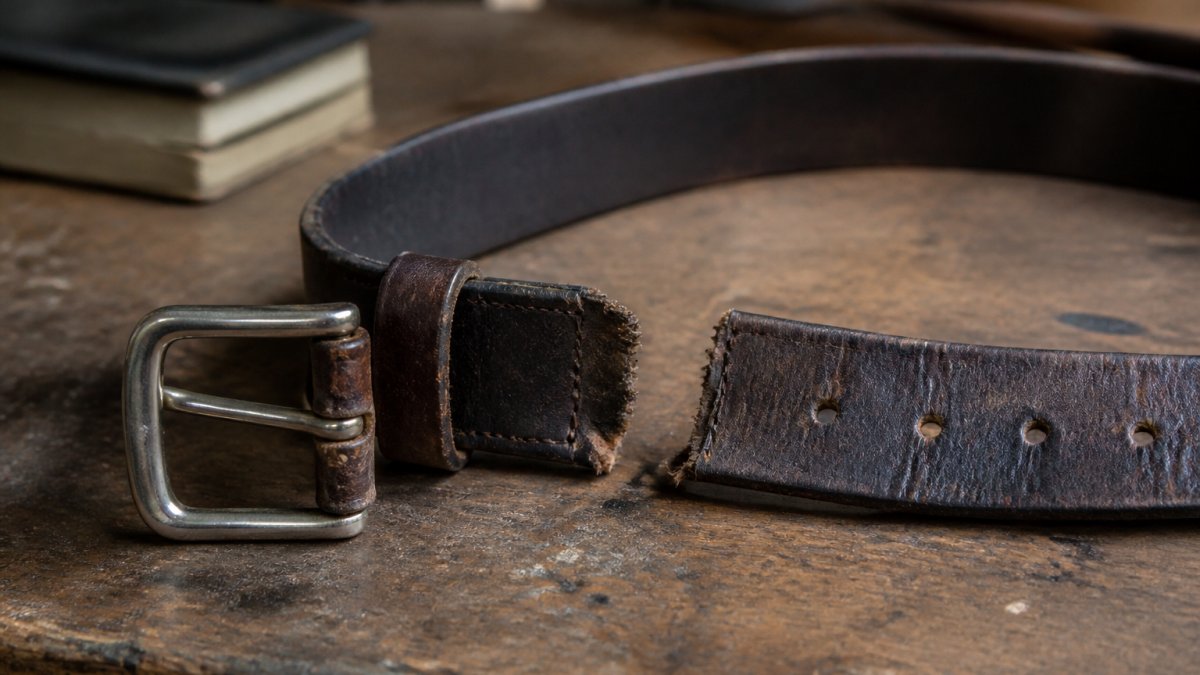
- Why Cheap Leather Belts Fail Under Tension
- Glue vs. Stitching: How Construction Decides Belt Longevity
- How to Identify High-Quality Leather: A Visual Inspection Guide
- Hardware Failure Analysis: When the Buckle Becomes the Weak Link
- Durable Leather Belts for Men: What to Look For Before You Buy
- Repairability vs. Replacement: The Long-Term Cost of Cheap Belts
- Frequently Asked Questions
Last Updated: October 2, 2026
The Anatomy of a Leather Belt: What You're Actually Buying
A leather belt is a strip of hide cut from one of two very different parts of the skin, and which part it comes from decides whether it lasts a decade or a season. Armour Belts builds every belt from the load-bearing layer.

The Grain Layer vs. the Split Layer
The grain layer is the dense, tightly packed outer surface of the hide, where fibers grow closest together. The split layer sits underneath, softer and looser, with fibers that separate under stress. Grain holds the strength; split supplies the bulk. When a belt sags under a holster or stretches at the holes, the grain layer is usually what gave out.
How Thickness and Fiber Density Determine Load-Bearing Capacity
Thickness alone is not strength. A thick belt cut from loose split leather still folds under weight because the fibers slide past each other. Fiber density is what resists that movement. This is the difference between a belt that carries a full-size pistol without rolling and one that sags by mid-afternoon.
Full-Grain vs. Bonded Leather Belts: The Core Difference
Full-grain leather keeps the entire grain layer intact, while bonded leather is a reconstituted sheet of shredded leather scraps and binder. The two look similar on a rack and behave nothing alike after a year of wear.
What Bonded Leather Is Really Made Of
Bonded leather glues leather fibers and dust onto a fabric or paper backing, then embosses a grain pattern on top. With no continuous grain layer, the surface and backing separate under tension, which is why bonded belts peel in sheets rather than wear through gradually.
| Belt Type | Material | Typical Lifespan | Failure Mode |
|---|---|---|---|
| Full-grain | Intact grain layer | Years of daily wear | Slow surface wear |
| Top-grain | Sanded grain layer | 1-3 years | Edge cracking |
| Genuine leather | Split or mixed layers | Months to 2 years | Stretching, sagging |
| Bonded leather | Glued leather fibers | Weeks to months | Peeling, delamination |
Why Cheap Leather Belts Fail Under Tension
Cheap leather belts fail because their internal structure cannot distribute the load a belt actually carries. A belt under a holster, tool pouch, or full magazine sees constant tensile stress at the holes, the buckle fold, and every bend point. Weak material concentrates that force instead of spreading it.
Tensile Strength and Structural Integrity
Tensile strength measures how much pull a material takes before it tears, and in leather that tracks directly to fiber density in the grain layer. Loose fibers in split or bonded material tear at the hole line first; once one hole deforms, damage accelerates.
Common Failure Points: Cracking, Peeling, and Hole Deformation
Three failures show up again and again on low-quality belts:
- Delamination and surface peeling: the top layer lifts away from the backing
- Fold cracking: the leather splits at the buckle fold where it flexes daily
- Hole deformation: holes stretch into ovals, then tear through
Glue vs. Stitching: How Construction Decides Belt Longevity
Stitching outlasts adhesive every time, because thread flexes with the leather while glue does not. Manufacturers glue layers to save labor, and that bond is the first thing to go under repeated flexing. Stitched construction, especially with military-grade nylon thread, holds layers through years of daily bending.
How to Identify High-Quality Leather: A Visual Inspection Guide
High-quality leather shows tight, irregular grain with no repeating pattern, and the cut edge reveals solid fiber all the way through. Fake grain repeats because it came off a stamping plate. Real grain never repeats.
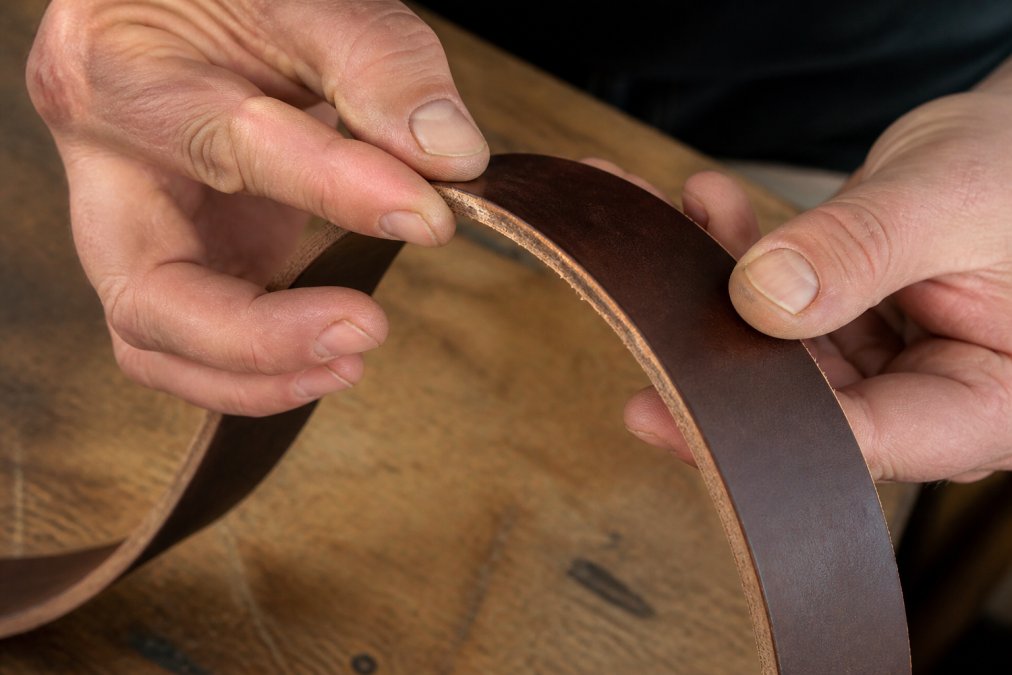
Five checks take under a minute:
- Edge finishing: burnished and sealed, not raw or painted
- Grain pattern: irregular and natural, not stamped and uniform
- Cut edge: solid fiber throughout, no fabric or paper core
- Thickness consistency: even along the full length
- Stitching: tight, even, and doubled at stress points
Hardware Failure Analysis: When the Buckle Becomes the Weak Link
Most belt guides treat the buckle as an accessory. On a load-bearing belt it is a structural component that fails on its own schedule. A belt can be cut from flawless full-grain leather, stitched with bonded nylon thread, and still dump a holster because the buckle was cast from a zinc alloy that work-hardened and snapped at the prong.
Buckle Metallurgy: Zinc Alloy vs. Solid Brass vs. Stainless Steel
The metal a buckle is made from decides how it behaves under load.
- Zinc alloy (pot metal): Die-cast from a zinc-aluminum blend, cheap and common on fashion belts. It is brittle: under a holster or tool pouch it develops hairline cracks at the prong base and frame corners, then fractures without warning. A cracked zinc buckle is scrap.
- Solid brass: A copper-zinc alloy that bends before it breaks, exactly what you want in a buckle. It work-hardens slowly, tolerates decades of flexing, and can be re-plated or polished. Heavier than zinc and more expensive.
- Stainless steel: The strongest common option and effectively corrosion-proof. It resists deformation better than brass under heavy static loads, which is why it shows up on duty and tactical belts. Harder to field-repair and heavier still.
Prong, Roller, and Frame Failure Modes
Buckles fail at predictable points:
- Prong fatigue: The prong is a cantilever, flexing at its base every time it is pushed through a hole and snapped back. On a thin zinc prong that flexing eventually cracks the casting; on brass or stainless it simply wears in.
- Frame deformation: A stamped frame can spread at the sides under tension, letting the prong slip out of the hole. This is the classic "belt won't stay tight" complaint, a hardware problem, not a leather problem.
- Roller seizure: Roller buckles reduce leather wear by letting the strap slide instead of rub. When the roller pin corrodes or the roller is stamped rather than machined, it stops turning and grinds the belt's finish.
- Prong-less plate and clamp buckles: These grip the leather with a friction plate or clamp. Cheap versions use smooth plates that slip; better versions use serrated plates that bite, but can crush the grain layer if the belt is too thin.
Attachment: Chicago Screws vs. Rivets vs. Stitched Buckle Folds
How the buckle attaches matters as much as the buckle itself.
- Chicago screws (binding posts): Two threaded halves that sandwich the leather. They let you swap buckles without cutting the belt and can be re-tightened with a screwdriver, which is why they are standard on quality carry belts. A drop of thread locker prevents backing out.
- Rivets: Fast and permanent. Tubular rivets hold well when set correctly, but cannot be removed without drilling, and a poorly set rivet loosens and wallows out the hole.
- Stitched buckle fold: The leather folds back on itself and is stitched. Strong and clean, but the buckle is married to the belt for life, and the fold cracks if the leather is not dense enough.
Why Hardware Failure Is a Safety Issue on a Carry Belt
On a dress belt, a failed buckle is an inconvenience. On a belt carrying a holstered firearm, it is a safety event. If the frame deforms or the prong releases, the belt loses tension, the holster shifts, and the draw stroke changes mid-motion. The leather may be perfect. The belt still failed.
Durable Leather Belts for Men: What to Look For Before You Buy
Durable leather belts for men share a short list of traits: full-grain construction, real stitching, solid hardware, and thickness matched to the load. Everything else is marketing. The FTC guidance on leather labeling is worth reading before you trust the word "genuine" on a tag, because the term describes a grade, not a guarantee.
Repairability vs. Replacement: The Long-Term Cost of Cheap Belts
A cheap belt is not a belt you buy once, it is a subscription. The purchase price is the smallest number in the transaction; the real cost is replacement frequency, the failure that happens at the wrong moment, and the material that goes to landfill because it was never designed to be fixed.
What Can Actually Be Repaired on a Leather Belt
A cobbler or leatherworker can perform a short list of repairs, and whether your belt qualifies depends on how it was built.
- Restitching: If the thread has rotted or worn through but the leather is sound, a shop can re-stitch the buckle fold and tip. The most common repair, and the cheapest.
- Buckle replacement: With Chicago screws you can do this yourself in two minutes with a screwdriver. On a riveted belt, a shop drills out the rivets and re-sets new ones. On a stitched-fold belt, the fold must be cut open and re-sewn, real labor.
- Hole repair: A stretched or torn hole can sometimes be backed with a leather patch and re-punched, but the repair is only as strong as the surrounding fiber. On split or bonded material, the patch has nothing to anchor to.
- Edge re-burnishing: Cosmetic and easy on full-grain. Pointless on a belt whose edge is painted over a fabric core.
- Conditioning and cleaning: Not a repair, but the maintenance that delays every other failure. A quality belt conditioned once or twice a year outlasts an unconditioned one by a wide margin.
Why Bonded and Genuine Leather Belts Cannot Be Saved
Bonded leather is a composite: leather fibers and dust glued to a fabric or paper scrim, with an embossed grain pattern pressed on top. There is no continuous fiber structure to stitch into, patch, or reinforce. When the surface separates from the backing, the failure is the material itself, not a seam that can be re-sewn.
Cost Per Year of Use: The Math That Actually Matters
Price tags are misleading because they ignore how long the belt lasts. The honest comparison is cost divided by years of service.
- A cheap belt that fails every six to twelve months has a cost per year that compounds, and each replacement carries the same risk of failing under load.
- A well-made full-grain belt that costs more up front but lasts a decade or more, with occasional conditioning and maybe one restitch, has a cost per year that drops every year you own it.
The Environmental Cost of Disposable Leather
Bonded leather is a disposal problem by design. Adhesives, synthetic binders, and a plastic or paper backing make it difficult to recycle and slow to break down, and because it cannot be repaired, every failure sends the whole belt to the trash.
A Repair-or-Replace Decision Framework
Run through these questions in order. The first "no" usually settles it.
- Is the leather solid fiber all the way through the cut edge? If no, replace it. There is nothing to repair.
- Is the failure in the thread, the buckle, or a single hole, not the leather itself? If yes, repair is likely worthwhile.
- Is the belt's construction stitched or screwed, not glued? If glued, the bond is the failure and it will keep failing.
- Is the belt worth more than the cost of the repair? A restitch and new buckle are inexpensive relative to a new quality belt; a full re-build usually is not.
- Has the belt already failed under load once? If yes, treat it as retired. A belt that has dropped a holster does not get a second chance.
Frequently Asked Questions
What are the most common causes of belt failure?
The most common causes are delamination in bonded leather, surface peeling where the top layer separates from the backing, and hole deformation from repeated stress at the buckle. Glue failure at the fold point and hardware that bends under load also contribute. Full-grain leather resists these issues because its fibers run through the entire thickness, giving it higher tensile strength and structural integrity than layered or reconstituted materials.
How can I tell if a leather belt is good quality?
Look at the edge: full-grain leather shows a solid, burnished edge, while bonded leather often looks painted or sealed over a fibrous core. Check the back for a suede-like split layer. Bend the belt firmly; quality leather creases without cracking or showing a plastic sheen. Also inspect the stitching, which should be tight and consistent, and the hardware, which should feel solid with no flex under hand pressure.
Why do leather belts crack around the holes?
Cracking at the holes happens when the leather lacks fiber density and tensile strength. Cheap belts use split leather or bonded leather with synthetic fillers that dry out and fracture under repeated stress. The hole area takes the most concentrated load every time you buckle the belt. Full-grain leather resists this because the grain layer stays intact and flexes without breaking down.
What is the difference between bonded leather and full-grain leather?
Bonded leather is made from leather scraps and dust mixed with adhesive, then pressed into sheets. It has no continuous grain layer, so it peels and delaminates. Full-grain leather is the entire top layer of the hide, with intact fibers running through the thickness. That structure gives full-grain leather far higher tensile strength, better load-bearing capacity, and the ability to develop a patina instead of cracking.
Most belts fail because the material was never built to carry a load, and no amount of care fixes a structural flaw. Armour Belts handcrafts full-grain leather gun belts in Michigan with military-grade stitching, precision sizing, and a lifetime warranty, so the belt holds its shape through years of daily carry. Get started with Armour Belts and carry with a belt that will not let you down.
Share:
How to Stop Holster Shifting: A Complete 2026 Guide
Relentless Tactical Alternative for Carry: 2026 Guide